Bird and Wildlife Photos
Featured Products
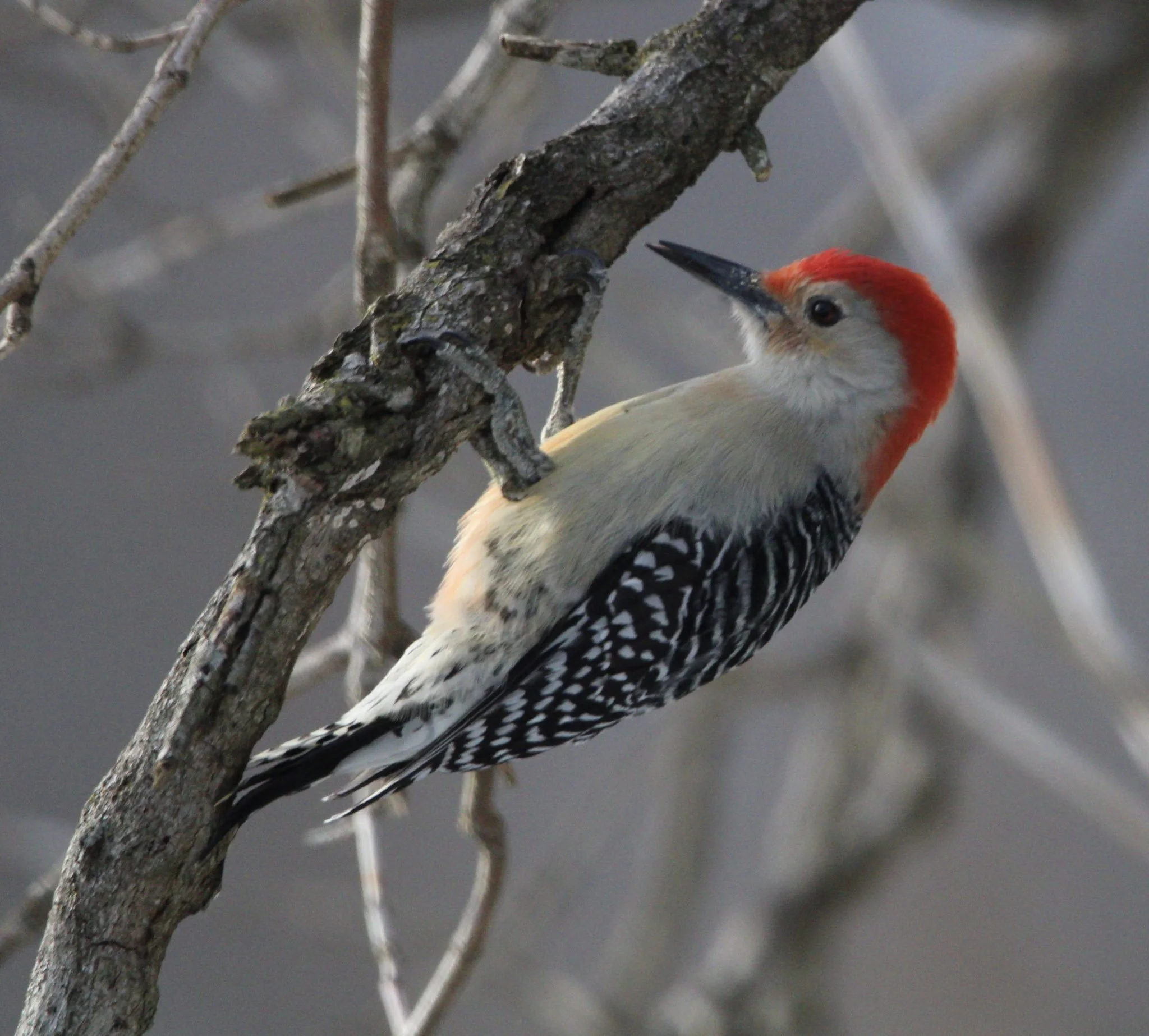
Red-bellied Woodpecker
Identification
Size: Medium (9–10 in)
Distinctive markings: Bold black-and-white barred back and wings; pale face and underparts; bright red cap (males: red from bill to nape; females: red on nape only)
Name note: Despite the name, the red on the belly is often faint and hard to see.
Behavior & Voice
Active, acrobatic forager often seen clinging to tree trunks and branches, sometimes feeding on suet feeders and peanut feeders in yards.
Diet: Insects, seeds, nuts, berries, and occasional fruit. Will cache food in tree crevices.
Call: A clear, rolling "churr" or "chick-a" series; also a short, sharp "kwirr" and rapid drumming.
Habitat & Range
Common across eastern United States in woodlands, suburban areas, parks, and backyard feeders.
Prefers deciduous forests and mixed woodlands but adapts well to orchards and neighborhoods with large trees.
Breeding & Nesting
Nest: Excavates cavity in dead or live trees, often 3–40 feet above ground.
Eggs: Typically 3–6 white eggs.
Both parents share incubation and feeding of chicks.
Territorial during breeding season; will chase other birds from nest area.
Tips for Photographing
Look for movement along trunks and branches; they'll often pause and peer before moving.
Use a moderate telephoto (300–600mm) for clean head-and-body shots; include some habitat for context.
Feeders with suet or peanuts attract them—position your blind or hide to hide motion and backlight for good catchlight in the eye.
Early morning and late afternoon provide softer light and more active behavior.
Fun Facts
They are excellent at clinging to smooth surfaces and can forage upside down.
Despite their striking head coloring, the belly streaking is usually pale — the species name
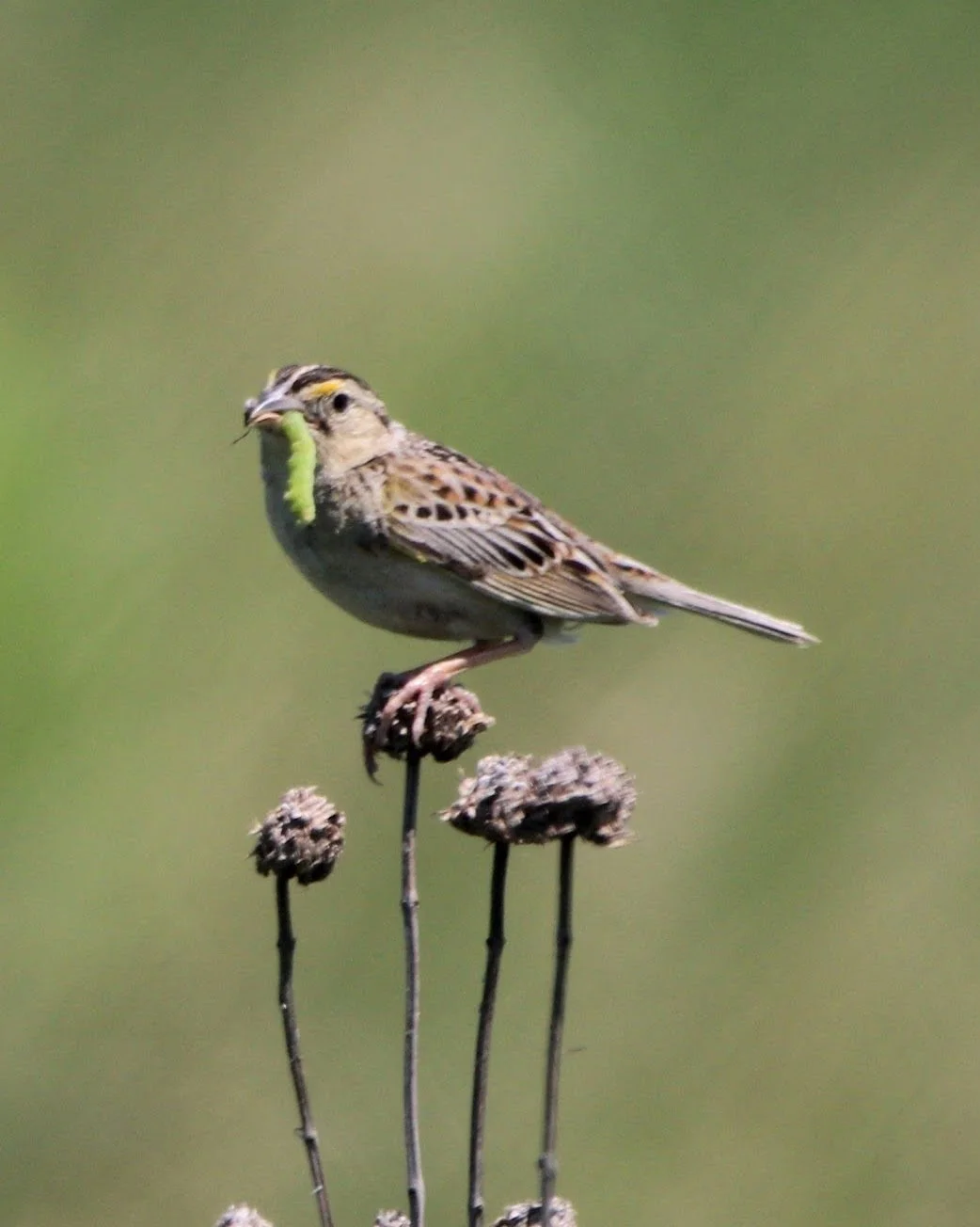
Grasshopper Sparrow, perched atop the dry seed heads in a Nebraska field, holds a bright green worm in its beak — a surprising splash of color against the muted golds and tans of late summer prairie. The sparrow’s compact body and streaked back blend with the stalks, but its softly rounded head and pale eye-ring give it a quietly confident look as it balances on the thin stems. The seed heads bow slightly underfoot, whispering with each small movement, while the bird’s short tail flicks once before it turns its head to swallow the prize.
This moment captures the everyday drama of grassland life: a tiny hunter mastering the vertical world of seed stalks, where the line between concealment and exposure is measured in inches. The worm—vivid, almost neon against the field’s earthy palette—speaks to the sparrow’s adaptability and the abundance of insect life that makes these habitats vital. Around the bird, the prairie hums softly with distant insect choruses and the occasional rustle of grasses; up close, the scene is intimate and focused, the sparrow’s intent expression revealing the single-mindedness of a parent provisioning or a bird securing a meal.
Photographing this requires a low, patient approach to avoid startling the bird, a telephoto lens to frame the delicate balance on the seed heads, and a light that flatters the warm, textured tones of the grass. Timing matters: early morning or late afternoon light will emphasize the sparrow’s subtle plumage—those soft streaks and warm buff underparts—while casting gentle shadows that give depth to the scene. The result is a portrait that’s both small in scale and big in story: survival, seasonality, and the quiet resilience of prairie life embodied in a single, green-beaked moment.
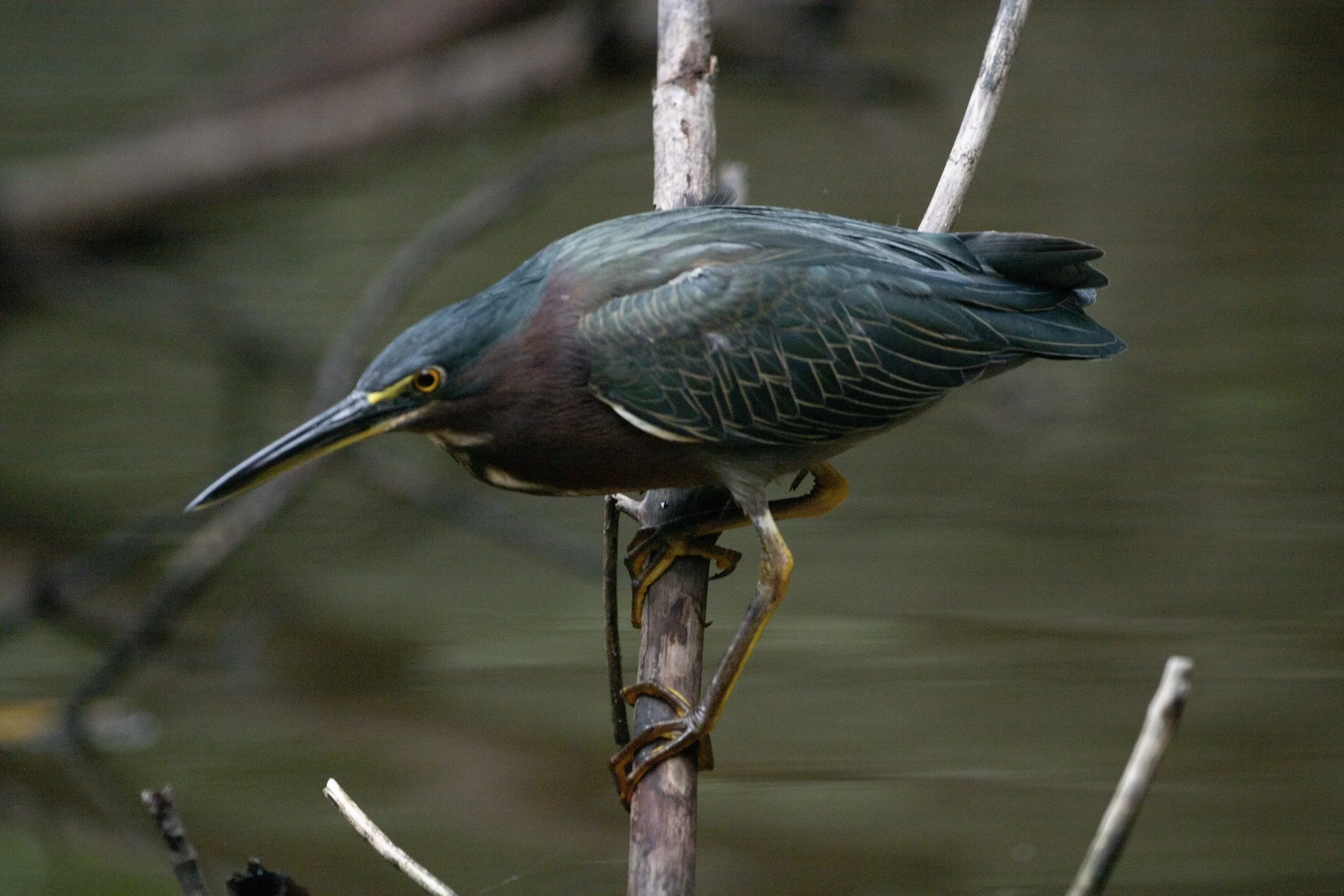
Green Heron — Big Cypress Nature Preserve, Florida
A compact, quietly confident hunter, the Green Heron (Butorides virescens) blends into the swampy tapestry of Big Cypress Nature Preserve with surprising stealth. At roughly the size of a crow but built for stalking, it often perches motionless on cypress knees, fallen logs, or low branches over dark water, waiting for the precise moment to strike.
Identification
Size: 16–18 inches (including neck), stocky body.
Plumage: Rich chestnut neck and chest, deep greenish-black cap, and iridescent greenish-black back that gives the species its common name. Wings show a brownish pattern when folded.
Legs and bill: Relatively short yellow-green legs; bill is long, straight, and sharp — perfect for spearing fish and crustaceans.
Juveniles: Streaked brown and buff, more rufous overall than adults.
Behavior and Feeding
Foraging style: Patient ambush predator. Often stands perfectly still, then lunges at small fish, frogs, insects, and crustaceans. They’re famous for occasional tool use — dropping bait (insects, feathers, or bread) to lure fish within striking distance.
Movement: Short, deliberate steps; when disturbed they prefer to freeze or glide away low over the water, unlike the taller, more ostentatious great blue heron.
Habitat in Big Cypress
Big Cypress offers the seasonally flooded cypress swamps, sloughs, and mangrove edges these herons favor. Slightly elevated perches, shallow edges, and tannin-stained water provide ideal hunting grounds.
Look for them along boardwalks, canal edges, and quiet backwaters where water is clear enough for prey to be visible but shaded enough for the heron to remain concealed.
Best Times to See One
Early morning and late afternoon are prime — when prey is active and light creates the contrast that reveals the heron’s silhouette.
During the dry season, when water levels concentrate fish and amphibians, feeding activity can be particularly intense.
Photographing Tips
Approach slowly and keep a low profile; Green Herons tolerate closer vantage points than larger herons but will bolt if you make sudden moves.
Use a telephoto lens (300mm or longer recommended) to capture close-up behavior without disturbance.
Aim for images that show the iridescent back or the rich chestnut neck; low-angle shots over water yield flattering reflections and a natural context.
Fast shutter speeds (1/1000s or faster) help freeze sudden lunges; continuous focus (AI-Servo/AF-C) tracks motion.
Conservation Notes
Currently widespread and considered of least concern, Green Herons nonetheless depend on healthy wetland ecosystems. Preservation of water quality, hydrology, and native vegetation in places like Big Cypress is essential to sustain their habitat and prey base.
Encounter impression
Seeing a Green Heron in Big Cypress is a reminder that the swamp’s smaller, quieter residents are as fascinating as their larger cousins. Their vivid colors and cunning hunting techniques reward patience — a brief, jewel-like moment amid the cypress and shadows.
Who
we are
Vicky Mattson Photography specializes in birds local to Ohio as well as from more exotic locales. She offers her best photos as prints, cards, and journals. Welcome to her online store!
Contact Us
Like more information? Fill out some info and we will be in touch shortly. We can’t wait to hear from you!